Exhibit A · Real exam papers, 1902–1914
Could you pass a 1914 eighth-grade exam?
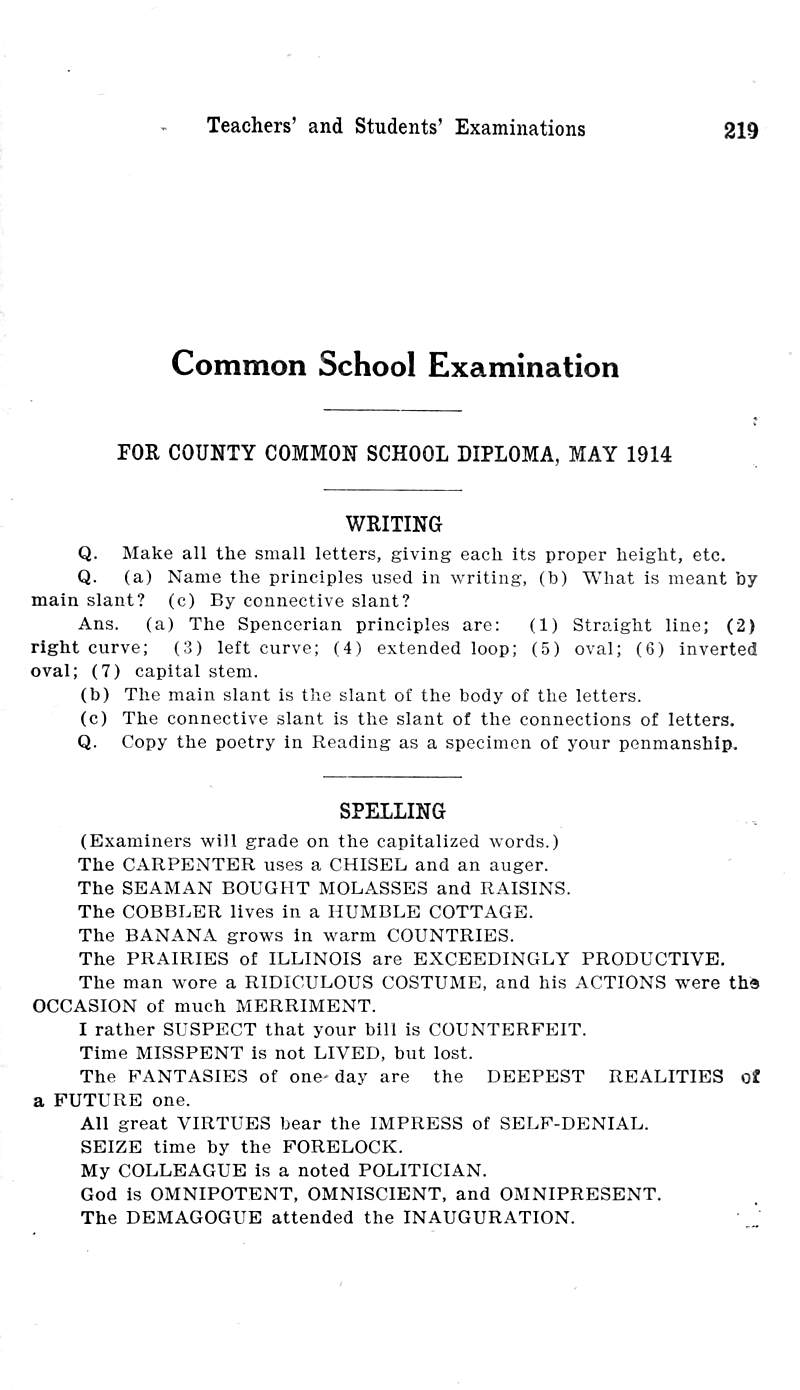
The real eighth-grade exams of the 1910s weren't harder math. They were bushels, bank notes and tobacco lectures, and in the two county reports we found (Marion Co. OH 1912, Fayette Co. OH 1914), most kids who sat them failed. Take 15 of the real questions and see if you'd have passed.
“Should not be used to compare student knowledge then and now.” That's the Bullitt County History Museum on the 1912 Bullitt County test it posts, and we agree. This is a window into what school asked of 13-year-olds, not a contest.
01 · Who passed
In both reports we found, most kids failed.
Caveat In the two county reports we found (Marion Co. OH 1912, Fayette Co. OH 1914). Two Ohio counties from a finite archive search, not a statewide rate.
Marion County, Ohio, 1912
62 of 199 passed (31.2%). Top average: 82.
Fayette County, Ohio, May 16, 1914
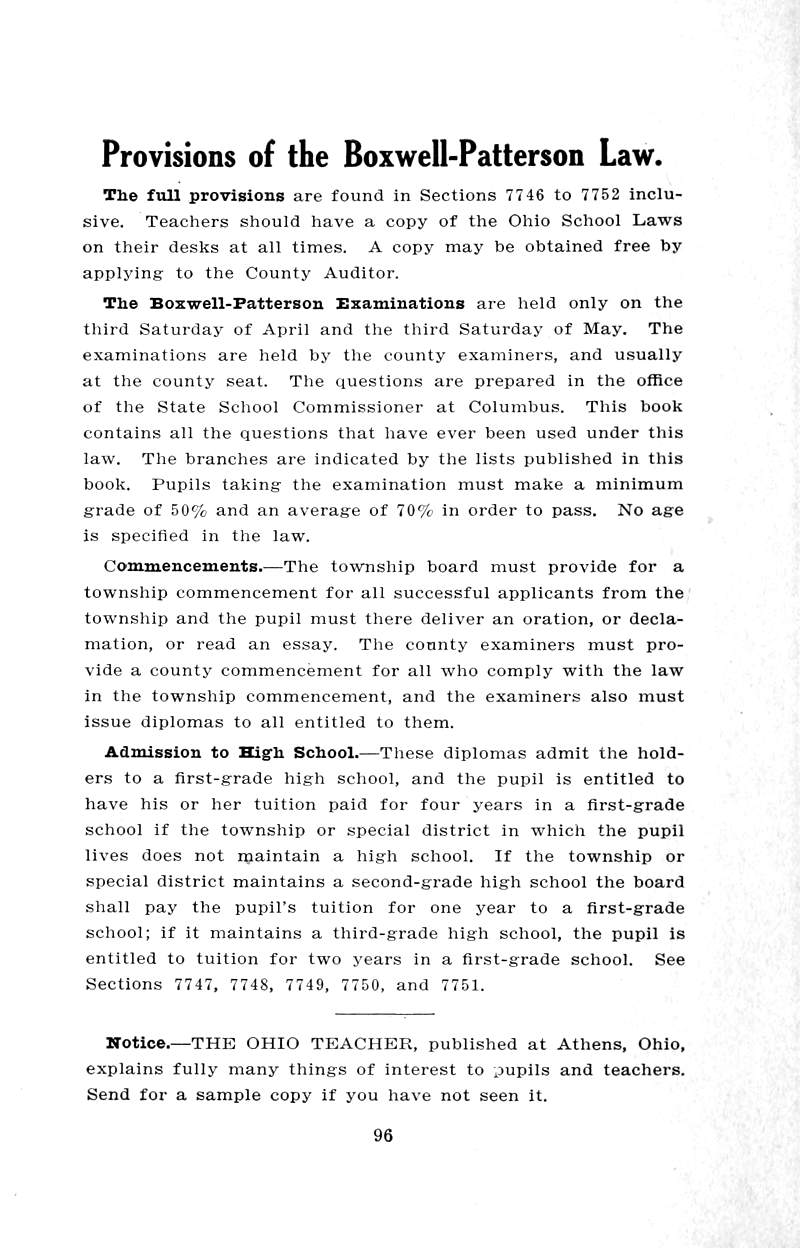
38 of 83 passed (45.8%). “The last to be held under the Boxwell-Patterson law.”
passed did not pass
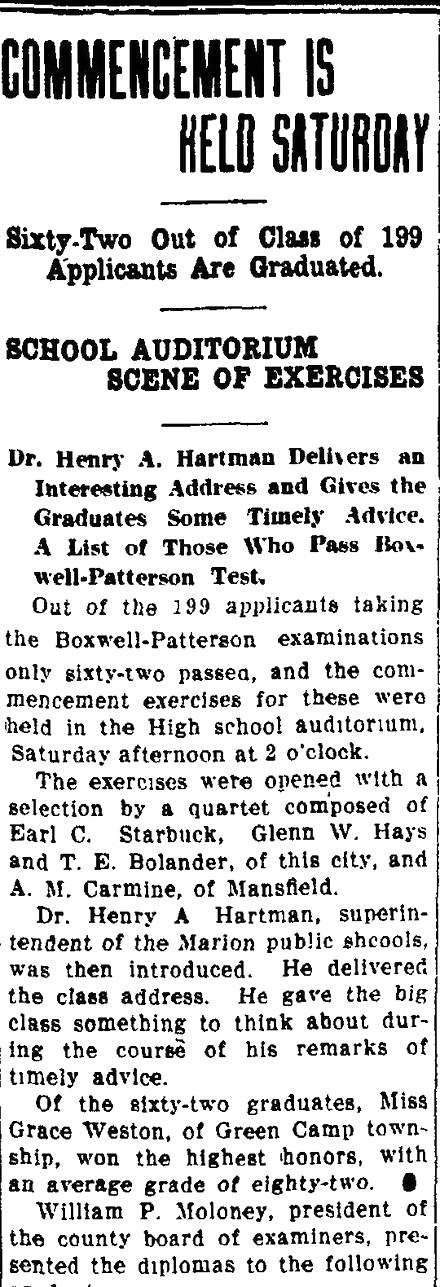
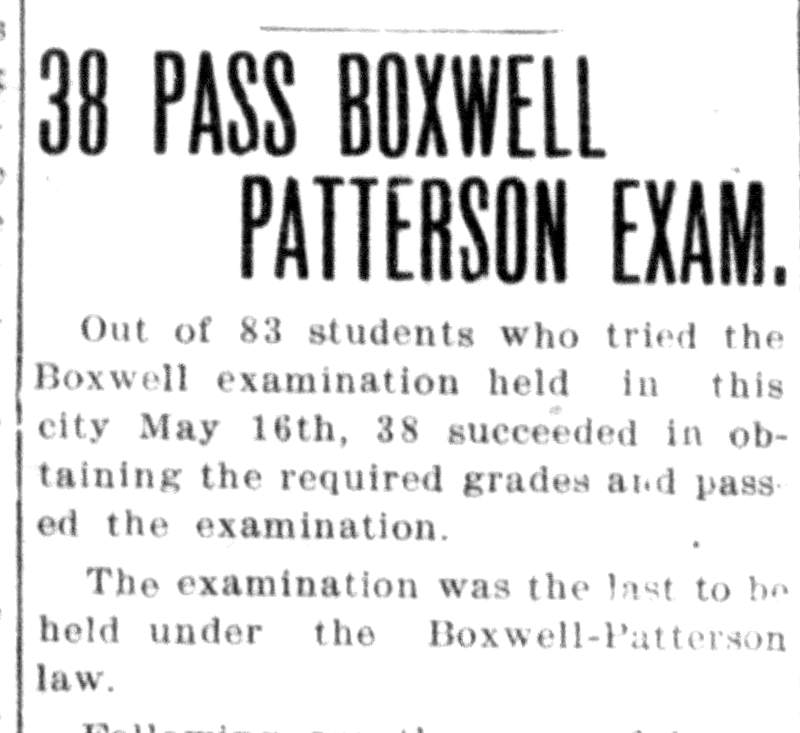
Ohio's rule was printed plainly: at least 50% in every subject and a 70% average. “No age is specified in the law.” Passing earned a township commencement, a diploma and four years of paid high-school tuition.
The exam · 15 questions
Could you pass? Most kids didn't.
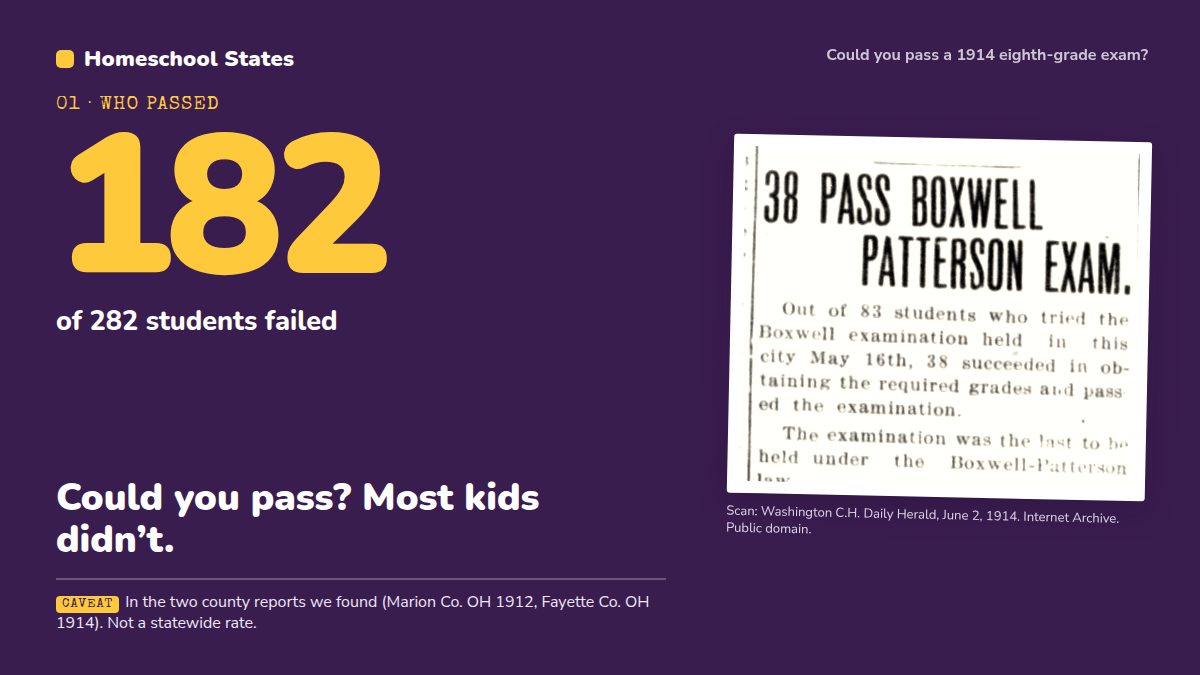
In the two county reports we found (Marion Co. OH 1912, Fayette Co. OH 1914), 182 of 282 failed.
Questions: Kentucky, May 1914. Scored with Ohio's printed 1912 rule; Kentucky's own pass mark isn't in the records we found. Answer choices other than the printed answer are ours.
Three questions in each of five subjects. Pick an answer and we'll show what the 1914 study guide printed. These are 1914 questions, not 1912: the 1912 Ohio book prints no answers.
02 · The arithmetic
The arithmetic is 5th-to-7th-grade math today. The bushels are the hard part.
Caveat Our classification of 29 legible problems (Kentucky 1914, Ohio 1902 and 1911). Common Core is today's standard, not 1912's.
- Kentucky, May 1914 Q2: dry-measure conversion with fractions (units: bushel; peck)
- Kentucky, May 1914 Q4: volume of a rectangular pile, then cords (units: cord)
- Kentucky, May 1914 Q6: volume then divide by a decimal (units: bushel)
- Ohio, Apr 19, 1902 Q7: volume, then a memorized bushel size (units: bushel)
- Ohio, Apr 19, 1902 Q9: area with decimals, then acres (units: acre)
- Ohio, Apr 19, 1902 Q10: fraction word problem (units: acre)
- Ohio, Apr 15, 1911 Q1: area in rods, acres, bushels, price (units: rod; acre; bushel)
- Kentucky, May 1914 Q1: eggs to dozens to dollars
- Kentucky, May 1914 Q8: decimal operations
- Kentucky, May 1914 Q9: add fractions and decimals
- Ohio, Apr 19, 1902 Q6: read/write decimals
- Ohio, Apr 15, 1911 Q4: decimal to fraction; decimal ops
- Ohio, Apr 15, 1911 Q5: area plus unit conversion
- Ohio, Apr 15, 1911 Q6: time units as a fraction
- Ohio, Apr 15, 1911 Q10: fraction word problem
- Kentucky, May 1914 Q5: unit-price comparison
- Kentucky, May 1914 Q10: find the whole from a percent
- Ohio, Apr 15, 1911 Q2: multi-digit add, multiply, divide
- Ohio, Apr 15, 1911 Q8: least common multiple
- Kentucky, May 1914 Q7: percent, interest and loss (units: bushel)
- Ohio, Apr 19, 1902 Q5: commission (units: bushel)
- Ohio, Apr 15, 1911 Q7: compound proportion (units: rod)
- Kentucky, May 1914 Q3: simple interest
- Ohio, Apr 19, 1902 Q1: vocabulary: factor/LCM, ratio, commission/interest
- Ohio, Apr 19, 1902 Q2: profit/loss and present worth
- Ohio, Apr 19, 1902 Q3: percent gain/loss
- Ohio, Apr 19, 1902 Q8: bank discount on a note
- Ohio, Apr 15, 1911 Q3: interest on a note
- Ohio, Apr 15, 1911 Q9: markup percent
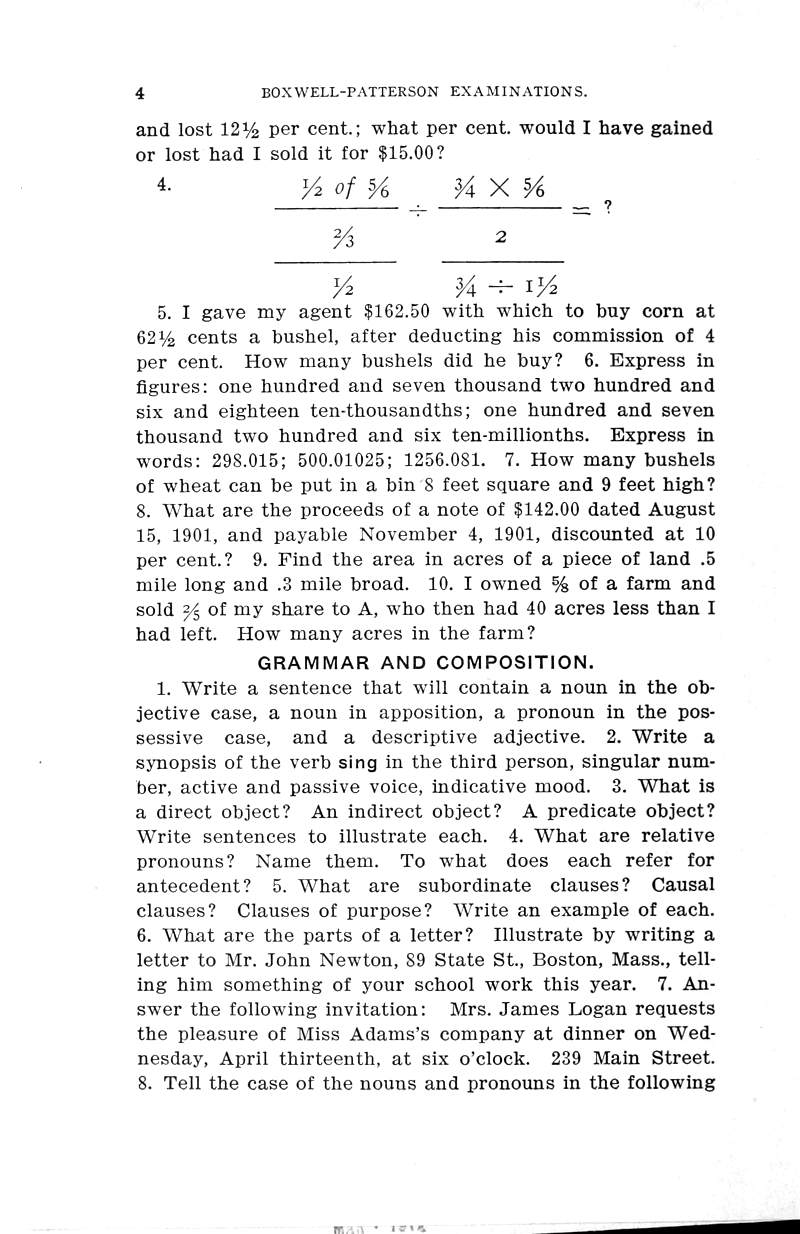
“How many bushels of wheat can be put in a bin 8 feet square and 9 feet high”Ohio, 1902
You'd need to know a bushel's volume. The exam doesn't give it. Across the 20 Ohio state exams, farm units turn up in 19 of 20 arithmetic sections: bushels in 13, acres in 15, rods in 10.
By our count: 15 problems at grade 5, 4 at grade 6, 10 at grade 7 (all percent, interest or commission).
03 · Business math
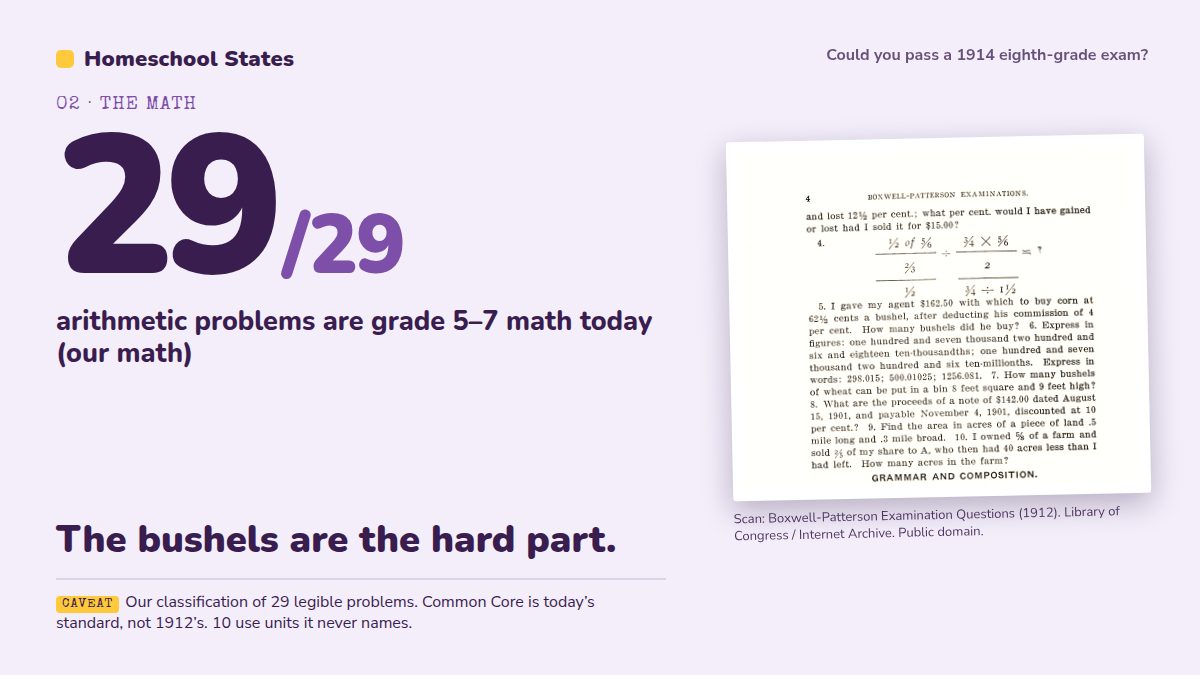
All 20 Ohio exams asked about notes, interest or commission.
Caveat 20 Ohio state exams, 1902–1911, as printed in a 1912 study guide. Keyword flags are ours (commission, interest, notes, discount, tax).
For value received, I promise to pay … One hundred fifteen dollars, with interest at 6%.
“What is the amount due April 15, 1911?”
— — —Set in type from the 1911 question's numbers (“A note of $115 was given August 1, 1910, drawing interest at 6%”). An illustration, not a real note.
One tile per exam, 1902–1911. Filled = banking or business arithmetic.
- 1902
- 1902
- 1903
- 1903
- 1903
- 1904
- 1905
- 1905
- 1906
- 1906
- 1907
- 1907
- 1908
- 1908
- 1909
- 1909
- 1910
- 1910
- 1911
- 1911
“What are the proceeds of a note of $142.00 dated August 15, 1901” (1902). “I gave my agent $162.50 with which to buy corn” (1902). Common Core still lists “simple interest … commissions” under 7th grade.
04 · Physiology
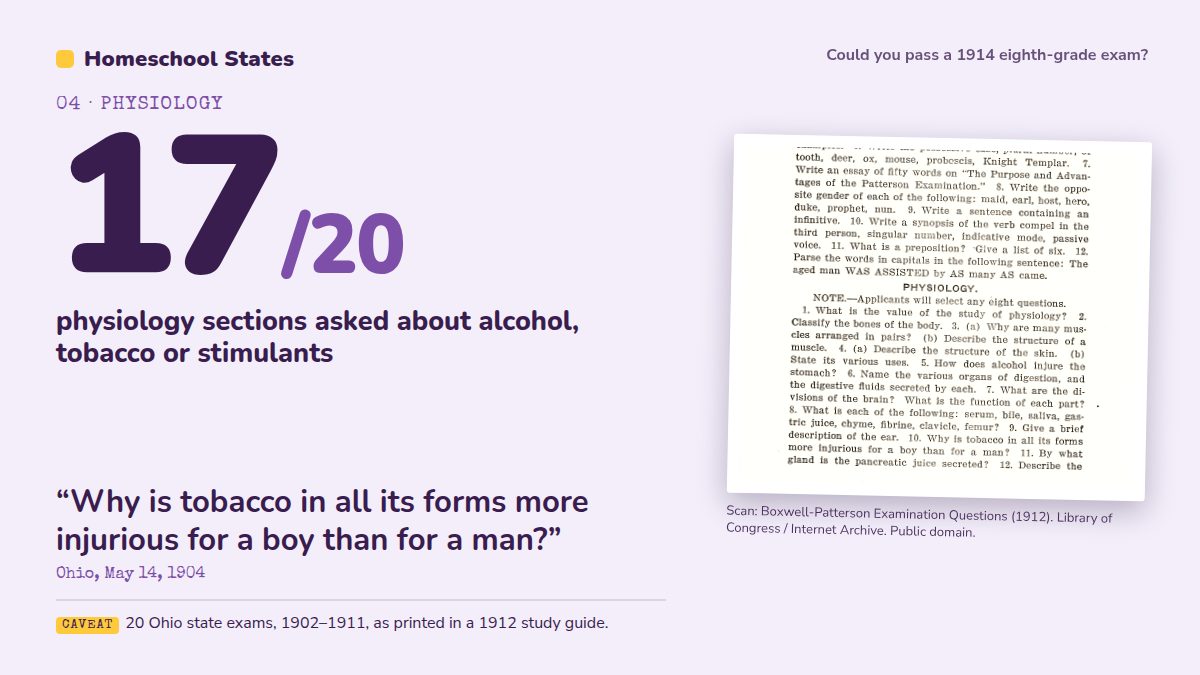
17 of 20 physiology sections asked about alcohol, tobacco or stimulants.
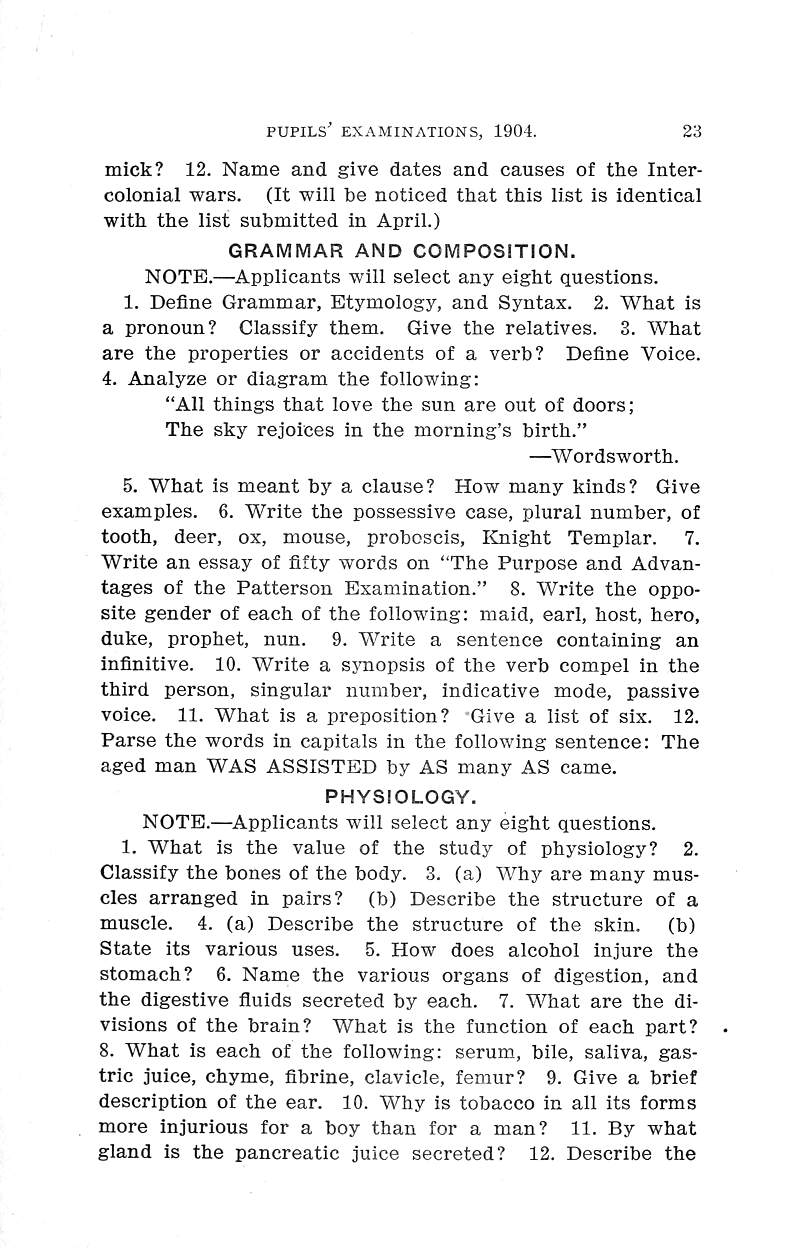
Caveat 20 Ohio state exams, 1902–1911. Three have none: 1905-05-13, 1909-04-17, 1910-05-21. Keyword list is ours.
One tile per exam. Filled = asked about alcohol, tobacco or stimulants.
- 1902
- 1902
- 1903
- 1903
- 1903
- 1904
- 1905
- 1905
- 1906
- 1906
- 1907
- 1907
- 1908
- 1908
- 1909
- 1909
- 1910
- 1910
- 1911
- 1911
“Why is tobacco in all its forms more injurious for a boy than for a man?”Ohio, May 14, 1904
“Is coffee a harmful stimulant?”Ohio state exam
“Why is it especially dangerous to perform surgical operations upon confirmed beer drinkers?”Ohio, 1908
05 · Penmanship
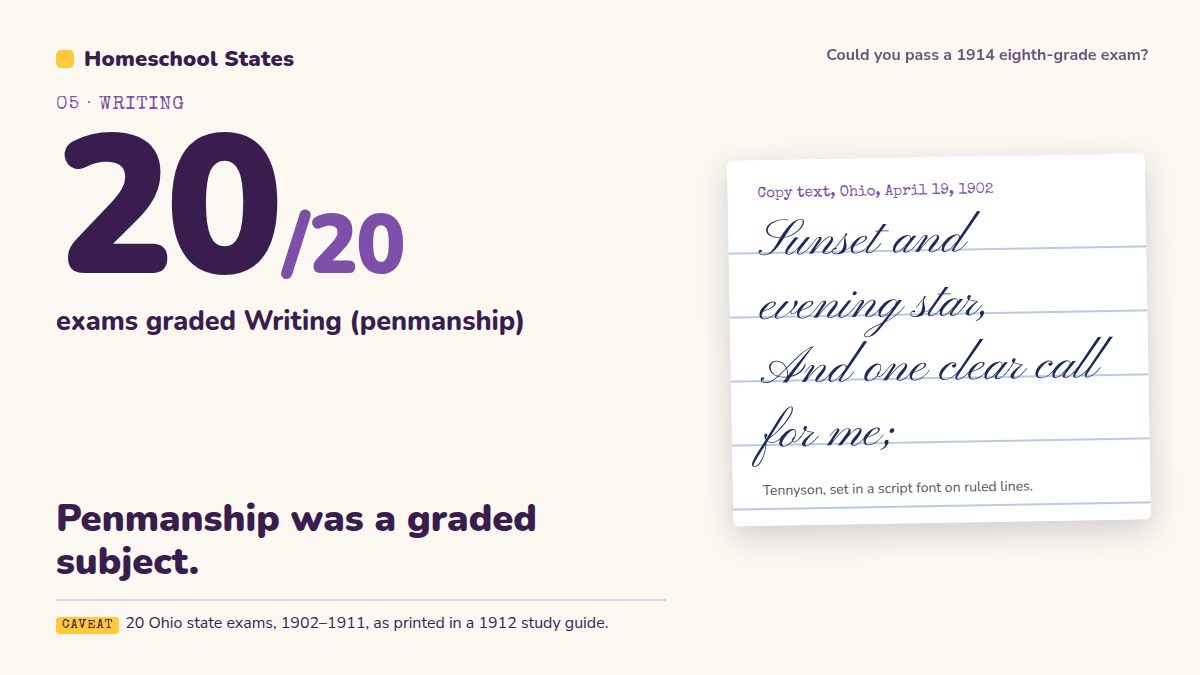
Penmanship was a graded subject on all 20 exams.
Caveat 20 Ohio state exams, 1902–1911, as printed in a 1912 study guide.
Copy text, Ohio, April 19, 1902
Sunset and evening star,
And one clear call for me;
One tile per exam. Filled = Writing graded.
- 1902
- 1902
- 1903
- 1903
- 1903
- 1904
- 1905
- 1905
- 1906
- 1906
- 1907
- 1907
- 1908
- 1908
- 1909
- 1909
- 1910
- 1910
- 1911
- 1911
Kentucky's 1914 key expected students to know “the Spencerian principles,” the strokes of the copybook hand.
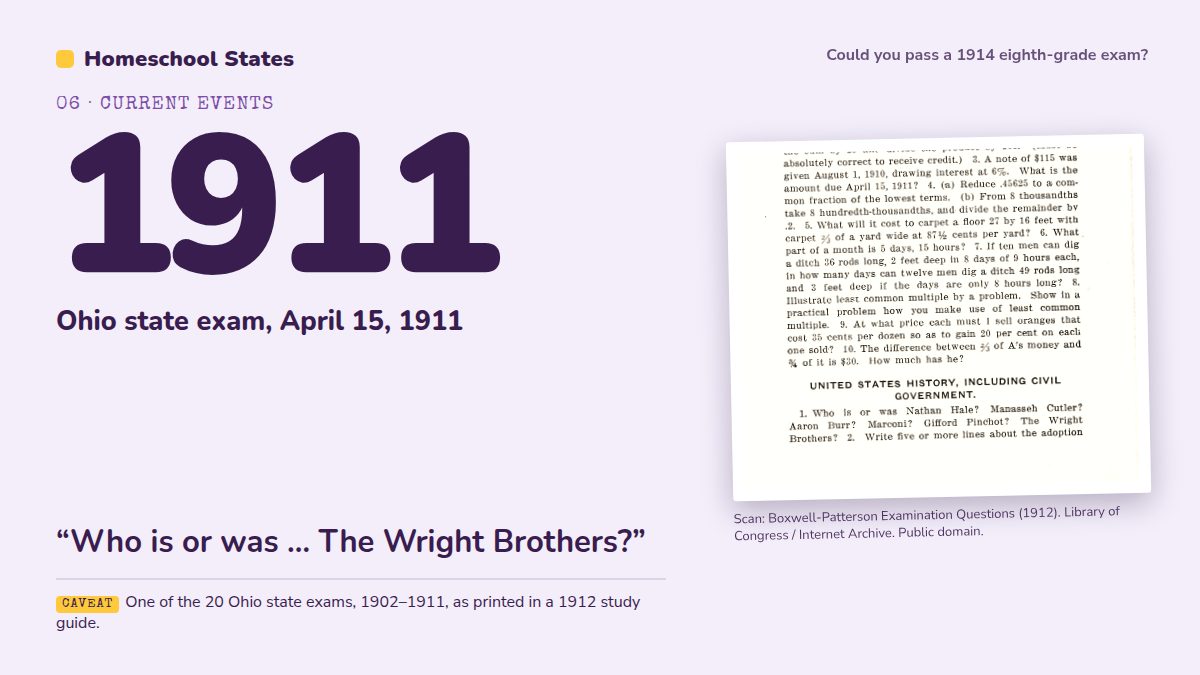
06 · Current events
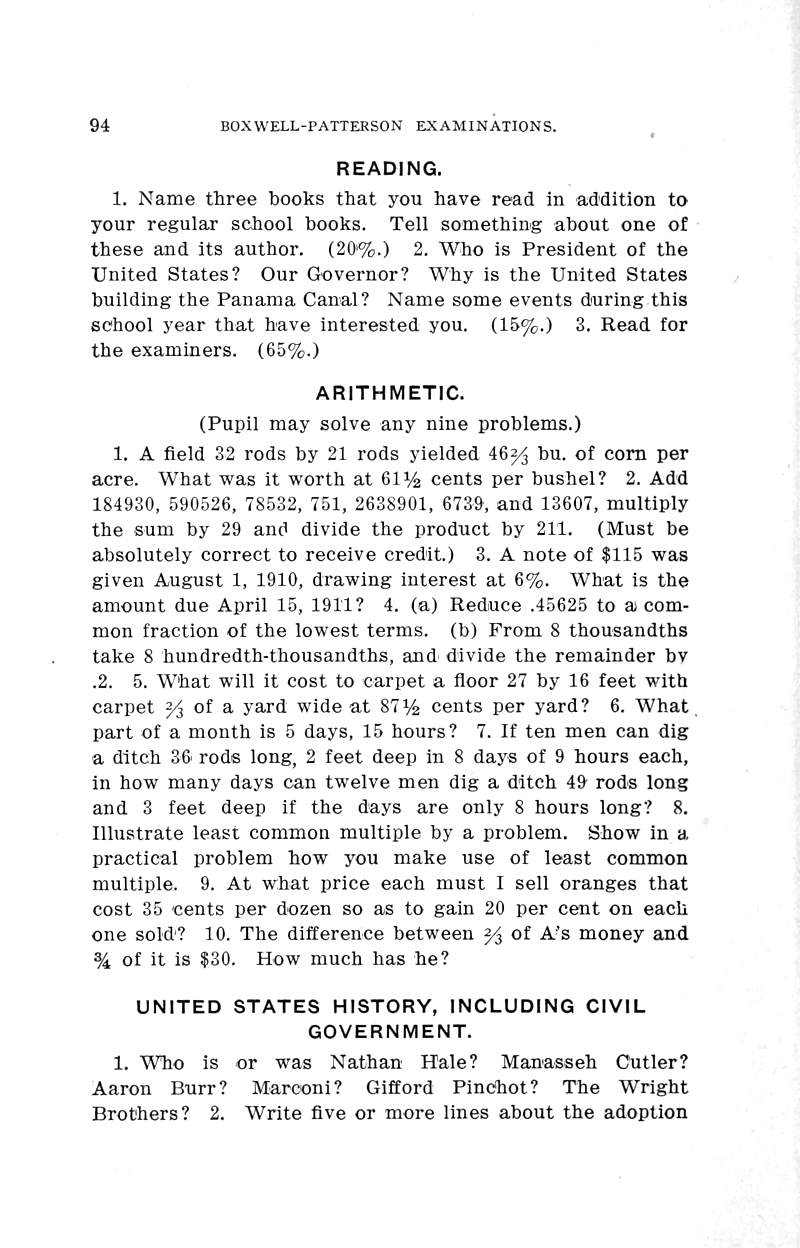
1911: “Who is or was … The Wright Brothers?”
Caveat Ohio state exams of 1902 and April 15, 1911, two of the 20 Ohio state exams, 1902–1911.
- 1902“Recount some of the troubles in South Africa”the Boer War
- 1911“Who is or was … Marconi? Gifford Pinchot? The Wright Brothers?”History & government
- 1911“Why is the United States building the Panama Canal?”Reading
07 · The answer key
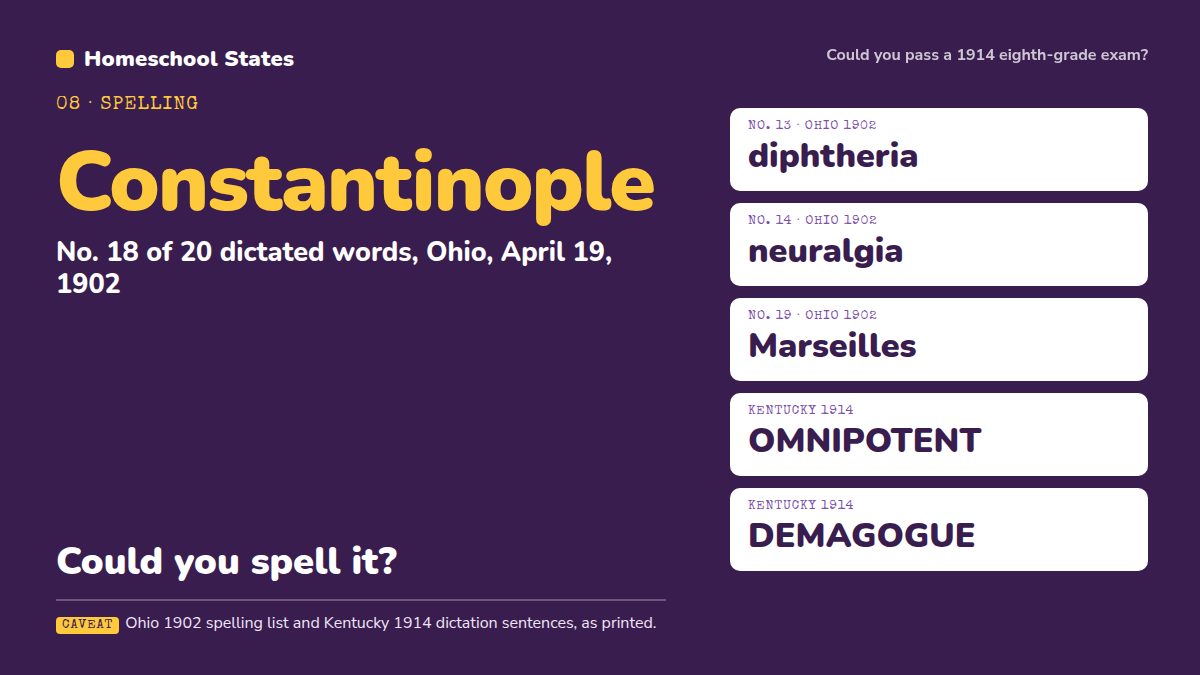
The printed answer key never says what the firewood sells for.
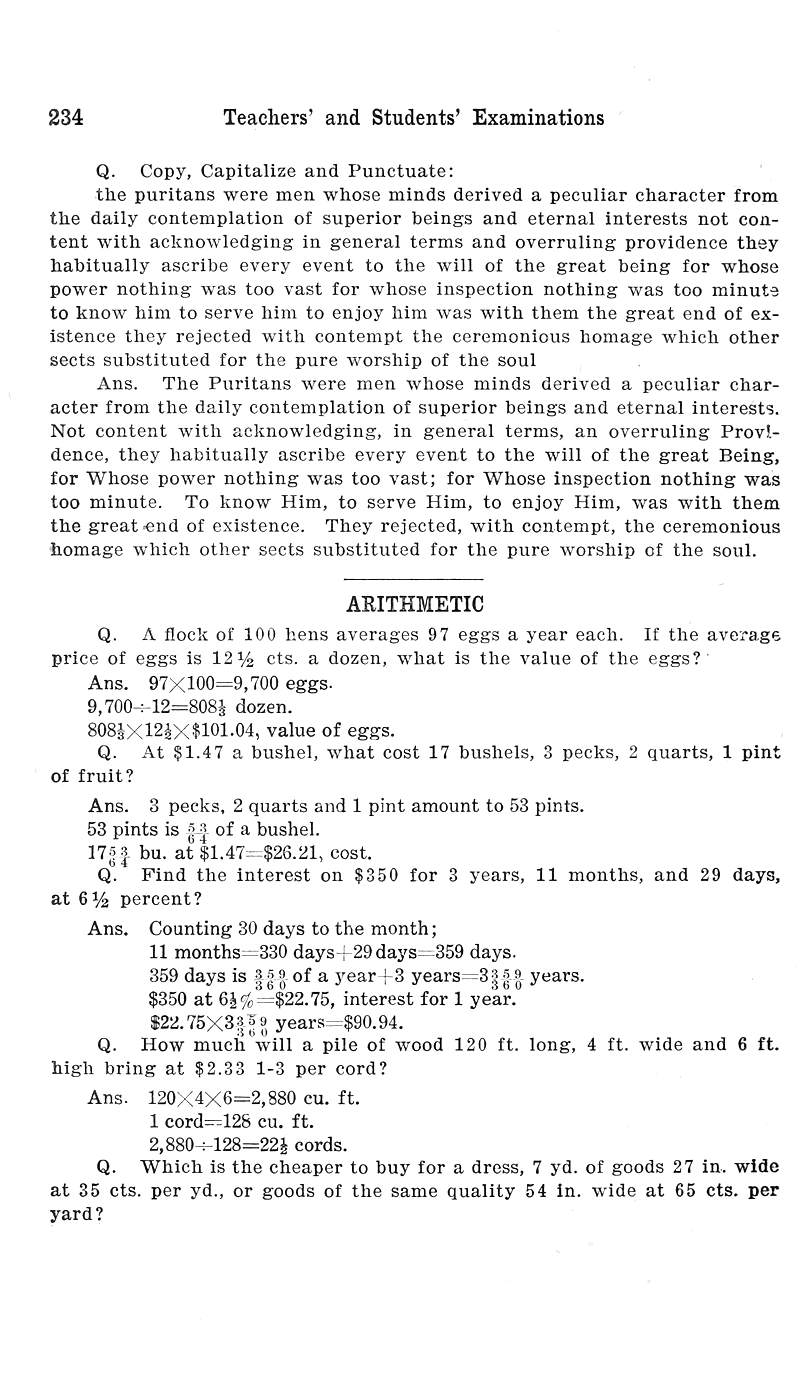
Caveat Kentucky 1914 study guide. The $52.50 (22½ cords at $2.33⅓ a cord) is our math, not printed.
The question asks what the pile will “bring at $2.33 1-3 per cord.” The key works out the volume and the cords and moves on. On another question it admits “Some words seem to have been omitted” from the printed exam.
08 · Spelling
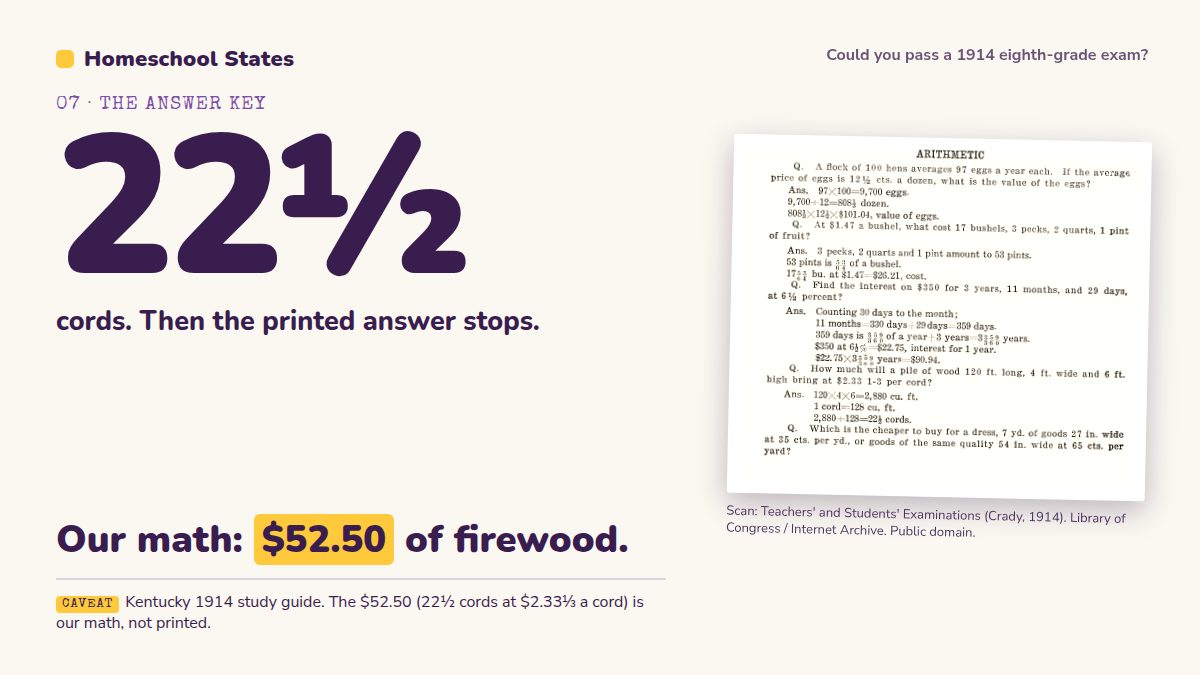
Constantinople, diphtheria, neuralgia: the spelling list.
Caveat Ohio 1902 spelling list and Kentucky 1914 dictation sentences, as printed.
- No. 18 · Ohio 1902Constantinople
- No. 13 · Ohio 1902diphtheria
- No. 14 · Ohio 1902neuralgia
- No. 19 · Ohio 1902Marseilles
- No. 20 · Ohio 1902Cincinnati
- Kentucky 1914OMNIPOTENT“God is OMNIPOTENT”
- Kentucky 1914DEMAGOGUE“The DEMAGOGUE attended…”
The data
Every exam, every problem, every pass report
The 20 Ohio state exams, 1902–1911
As printed in Boxwell-Patterson Examination Questions (1912). Flags are ours, from keyword lists. Tap a column name to sort. CSV
| 1902-04-19 | 8 | bushel, acre | Yes | Yes |
| 1902-05-10 | 8 | acre, rod, cord | Yes | Yes |
| 1903-04-16 (printed date; a Thursday, likely a misprint) | 8 | bushel | Yes | Yes |
| 1903-04-18 | 8 | bushel, acre | Yes | Yes |
| 1903-05-09 | 8 | bushel, acre, rod | Yes | Yes |
| 1904-05-14 | 7 | bushel | Yes | Yes |
| 1905-04-15 | 8 | bushel, acre, rod | Yes | Yes |
| 1905-05-13 | 8 | acre | Yes | No |
| 1906-04-21 | 8 | acre, rod, cord | Yes | Yes |
| 1906-05-12 | 8 | rod | Yes | Yes |
| 1907-04-20 | 8 | none flagged | Yes | Yes |
| 1907-05-11 | 8 | acre | Yes | Yes |
| 1908-04-18 | 8 | bushel, peck, acre | Yes | Yes |
| 1908-05-09 | 8 | bushel, acre, rod | Yes | Yes |
| 1909-04-17 | 8 | acre, board feet | Yes | No |
| 1909-05-08 | 8 | bushel, peck, acre, rod | Yes | Yes |
| 1910-04-16 | 8 | bushel | Yes | Yes |
| 1910-05-21 | 8 | bushel, acre, rod | Yes | No |
| 1911-04-15 | 7 | bushel, acre, rod | Yes | Yes |
| 1911-05-20 | 8 | bushel, acre, rod | Yes | Yes |
| Total | 19 of 20 | 20 of 20 | 17 of 20 |
29 arithmetic problems, mapped to Common Core (our classification)
Excerpts are OCR text, uncorrected. Code and grade are ours, checked against the CCSS Math document. Ohio 1902 Q4 is left out (OCR too garbled). CSV
| Excerpt (OCR) | Topic (ours) | Units Common Core never names | ||||
|---|---|---|---|---|---|---|
| Kentucky, May 1914 | 1 | A flock of 100 hens averages 97 eggs a year each | eggs to dozens to dollars | 5.NBT.B.7 | 5 | — |
| Kentucky, May 1914 | 2 | At $1.47 a bushel, what cost 17 bushels, 3 pecks, 2 quarts, 1 pint | dry-measure conversion with fractions | 5.MD.A.1 | 5 | bushel, peck |
| Kentucky, May 1914 | 3 | Find the interest on $350 for 3 years, 11 months, and 29 days | simple interest | 7.RP.A.3 | 7 | — |
| Kentucky, May 1914 | 4 | How much will a pile of wood 120 ft. long, 4 ft. wide and 6 ft. high bring | volume of a rectangular pile, then cords | 5.MD.C.5 | 5 | cord |
| Kentucky, May 1914 | 5 | Which is the cheaper to buy for a dress | unit-price comparison | 6.RP.A.3 | 6 | — |
| Kentucky, May 1914 | 6 | One bushel of corn on the cob occupies approximately | volume then divide by a decimal | 5.MD.C.5 | 5 | bushel |
| Kentucky, May 1914 | 7 | Corn shrinks about 1-5 its entire weight the first 6 months | percent, interest and loss | 7.RP.A.3 | 7 | bushel |
| Kentucky, May 1914 | 8 | Multiply the svim of 6.205 and 25 by their difference | decimal operations | 5.NBT.B.7 | 5 | — |
| Kentucky, May 1914 | 9 | Add V2+%+V5 to 2.45+.005 | add fractions and decimals | 5.NF.A.1 | 5 | — |
| Kentucky, May 1914 | 10 | If .16 of a hired man's monthly v/ages is $4.80 | find the whole from a percent | 6.RP.A.3 | 6 | — |
| Ohio, Apr 19, 1902 | 1 | Define factor, ratio, commission, least common multiple, interest | vocabulary: factor/LCM, ratio, commission/interest | 7.RP.A.3 | 7 | — |
| Ohio, Apr 19, 1902 | 2 | How do you find the cost price when the selling price and rate of gain are given | profit/loss and present worth | 7.RP.A.3 | 7 | — |
| Ohio, Apr 19, 1902 | 3 | I sold an article for $17.50 | percent gain/loss | 7.RP.A.3 | 7 | — |
| Ohio, Apr 19, 1902 | 5 | I gave my agent $162.50 with which to buy corn | commission | 7.RP.A.3 | 7 | bushel |
| Ohio, Apr 19, 1902 | 6 | Express in figures: one hundred and seven thousand two hundred and six and eighteen ten-thousandths | read/write decimals | 5.NBT.A.3 | 5 | — |
| Ohio, Apr 19, 1902 | 7 | How many bushels of wheat can be put in a bin 8 feet square and 9 feet high | volume, then a memorized bushel size | 5.MD.C.5 | 5 | bushel |
| Ohio, Apr 19, 1902 | 8 | What are the proceeds of a note of $142.00 dated August 15, 1901 | bank discount on a note | 7.RP.A.3 | 7 | — |
| Ohio, Apr 19, 1902 | 9 | Find the area in acres of a piece of land .5 mile long and .3 mile broad | area with decimals, then acres | 4.MD.A.3 | 5 | acre |
| Ohio, Apr 19, 1902 | 10 | I owned % of a farm and sold | fraction word problem | 5.NF.A.1 | 5 | acre |
| Ohio, Apr 15, 1911 | 1 | A field 32 rods by 21 rods yielded | area in rods, acres, bushels, price | 5.MD.A.1 | 5 | rod, acre, bushel |
| Ohio, Apr 15, 1911 | 2 | Add 184930, 590526, 78532, 751, 2638901, 6739, and 13607 | multi-digit add, multiply, divide | 6.NS.B.2 | 6 | — |
| Ohio, Apr 15, 1911 | 3 | A note of $115 was given August 1, 1910, drawing interest at 6% | interest on a note | 7.RP.A.3 | 7 | — |
| Ohio, Apr 15, 1911 | 4 | Reduce .45625 to a common fraction of the lowest terms | decimal to fraction; decimal ops | 5.NBT.B.7 | 5 | — |
| Ohio, Apr 15, 1911 | 5 | What will it cost to carpet a floor 27 by 16 feet | area plus unit conversion | 4.MD.A.3 | 5 | — |
| Ohio, Apr 15, 1911 | 6 | What, part of a month is 5 days, 15 hours | time units as a fraction | 5.MD.A.1 | 5 | — |
| Ohio, Apr 15, 1911 | 7 | If ten men can dig a ditch 36 | compound proportion | 7.RP.A.3 | 7 | rod |
| Ohio, Apr 15, 1911 | 8 | lUustrate least common multiple by a problem | least common multiple | 6.NS.B.4 | 6 | — |
| Ohio, Apr 15, 1911 | 9 | At what price each must I sell oranges that cost 35 | markup percent | 7.RP.A.3 | 7 | — |
| Ohio, Apr 15, 1911 | 10 | The difference between ^ of A | fraction word problem | 5.NF.A.1 | 5 | — |
Pass reports we found
The only two newspaper reports of Boxwell results we found in the Internet Archive. CSV
| Place | Exam | Took it | Passed | Pass rate | Top average | Source |
|---|---|---|---|---|---|---|
| Marion County, Ohio | spring 1912 (Boxwell-Patterson) | 199 | 62 | 31.2% | 82 | Marion Weekly Star, 1912-07-06 |
| Fayette County, Ohio (exam at Washington Court House) | 1914-05-16 | 83 | 38 | 45.8% | not given | Washington Court House Daily Herald, 1914-06-02 |
| Both reports | 282 | 100 | 35.5% |
Methods
How we counted
- Split the 1912 Ohio book into exams. It prints 20 state exams (April and May, 1902–1911) and county sets from 1900–1901. Story counts use the 20 state exams only.
- Flagged each section with keyword lists. Farm units, business math (commission, interest, notes, discount, tax) and alcohol/tobacco/stimulants. Then we mapped 29 legible arithmetic problems to Common Core codes by hand.
- Took pass counts from the newspapers. Two reports, two Ohio counties. The quiz uses Kentucky's May 1914 exam and its printed answers, scored with Ohio's printed rule.
What is printed, and what is ours
Printed: every exam question, the Kentucky answers, the Ohio pass rule and the newspaper pass counts.
Ours: OCR cleanup, splitting the book into exams, the keyword flags, the Common Core grades, the quiz's wrong answer choices, applying Ohio's rule to the Kentucky quiz, the $52.50 firewood price and every percentage.
Not verified: Kentucky's own diploma pass mark; 2 of the 11 county sets the publisher mentions (unreadable); any pass rates beyond the two reports; who wrote the Kentucky answers.
Quiz details. Question wording is from the printed exam, trimmed to one part where a question had several (we say so on the card). OCR noise in answers is fixed only where the printed text makes it plain. Each subject scores correct out of 3; you pass with an average of at least 70% and no subject under 50%, which works out to 11 or more of 15 with at least 2 in every subject.
Not claimed: that kids were smarter then, that the test was impossible, or that every American child took it. The Bullitt County History Museum says of the 1912 Bullitt County test it posts that it “should not be used to compare student knowledge then and now.”
Sources
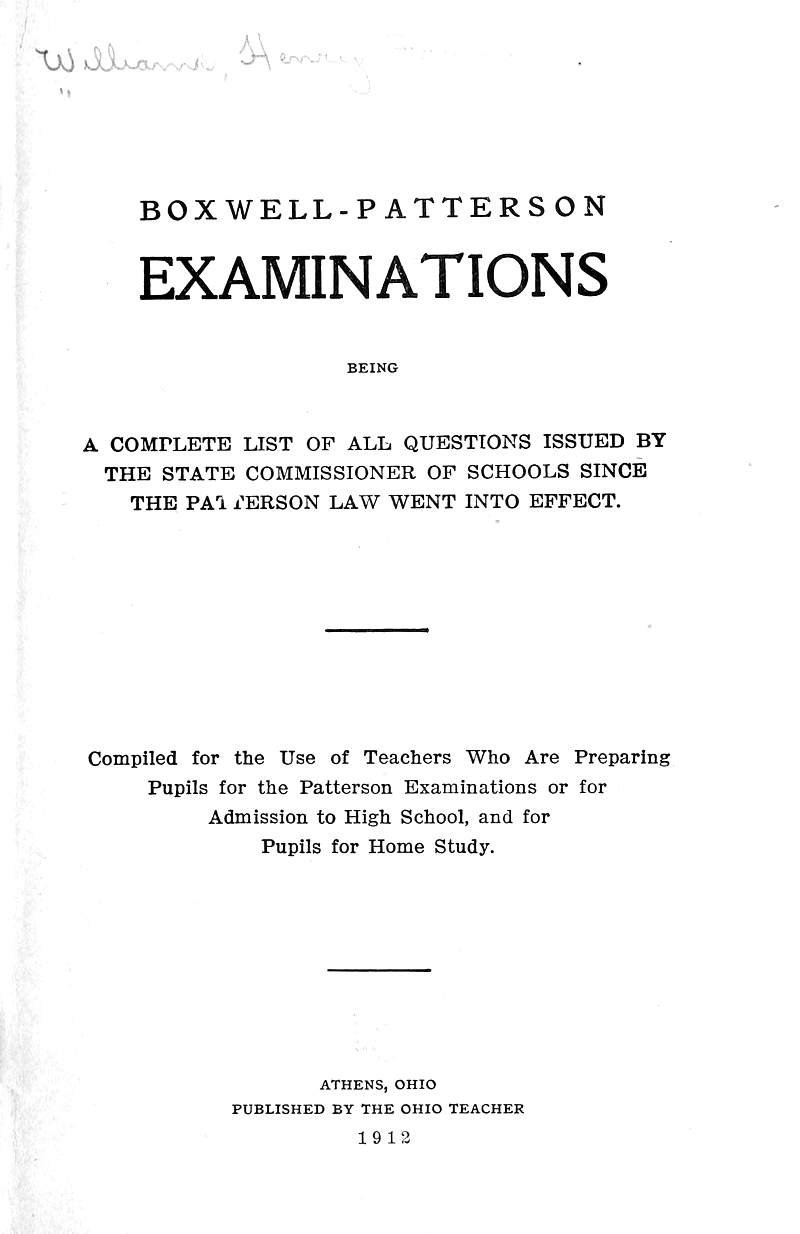
- Boxwell-Patterson Examination Questions, comp. Williams, The Ohio Teacher, Athens OH, 1912. Internet Archive (Library of Congress copy). Public domain.
- Teachers' and Students' Examinations, ed. Crady, Cynthiana KY, © 1914. Internet Archive (Library of Congress copy). Public domain.
- Marion Weekly Star, July 6, 1912. Internet Archive. Public domain.
- Washington C.H. Daily Herald, June 2, 1914. Internet Archive. Public domain.
- Common Core State Standards for Mathematics, © 2010 NGA Center / CCSSO. PDF. Used for standard codes and one quoted phrase.
- Bullitt County History Museum, 1912 Bullitt County test page. Quoted caveat only.
Downloads
Scan credits. Boxwell-Patterson Examination Questions (1912). Library of Congress / Internet Archive. Public domain. Teachers' and Students' Examinations (Crady, 1914). Library of Congress / Internet Archive. Public domain. Marion Weekly Star, July 6, 1912. Internet Archive. Public domain. Washington C.H. Daily Herald, June 2, 1914. Internet Archive. Public domain. All visuals other than scans are drawn in code from the data.